Sheffield Council Takes Stand Against Asylum Destitution


It is now some ten years since the Government started to use destitution as a weapon in its efforts to persuade refused asylum seekers to leave this country.  It was the shock of this decision and concern at the human misery that it would cause which led to the creation of ASSIST in Sheffield in 2003 in order to provide the necessary local support on a voluntary basis. This has been a remarkable success.


Indignation about destitution was also one of the factors which led in 2007 to the foundation of the South Yorkshire Migration and Asylum Action Group (SYMAAG) to campaign for better treatment for asylum seekers and other migrants. At about the same time, City of Sanctuary was born in Sheffield with the objective of building a culture of hospitality for asylum seekers and refugees. In 2007 Sheffield City Council passed unanimously a resolution designating Sheffield as the UK’s first City of Sanctuary. Since then, City of Sanctuary has spread to 24 other towns and cities, with a further dozen groups in formation.


These are but part of an extensive network of asylum support charities and campaigning organisations which has emerged all over the country. More than fifty of these organisations are affiliated to ‘Still Human Still Here’ Coalition, together with the Anglican Archbishops’ Council, the Catholic Bishops Conference and other important faith bodies.  This coalition campaigns specifically for an end to asylum destitution and the removal of most of the restrictions on asylum seekers working.


It is depressing  that, despite ten years of effort, asylum destitution  remains in place in Government policy and legislation. Unfortunately, politicians seem reluctant to listen to the knowledge and experience of those who actually know asylum seekers and are directly involved in supporting them. Instead, politicians are excessively influenced by the prejudices and misinformation aired daily in parts of the media. But the campaigning efforts will continue. It was recently decided to keep Still Human Still Here in existence as a campaigning body.

Glasgow, Bristol, Sheffield, your city next…

Recently, a new form of protest about asylum destitution has come onto the scene, reflecting the sense of outrage of city councils that there should be Government policies which actually create destitution on city streets. This began in Glasgow, where in June 2012 the City Council overwhelmingly passed a resolution condemning the UK Border Agency’s policy of forcing people seeking asylum into destitution. Then in January 2013  Bristol City Council passed a similar motion.


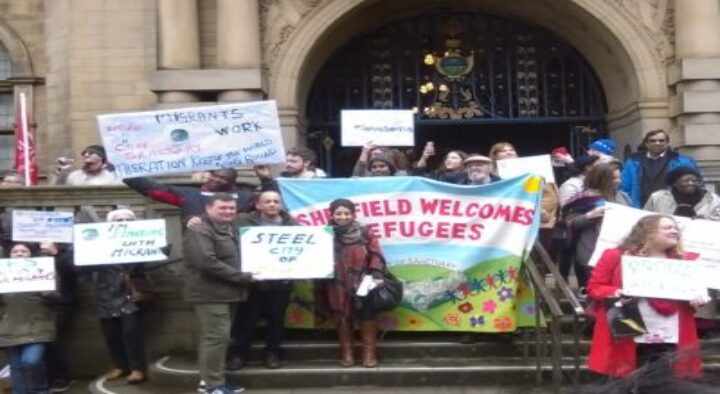
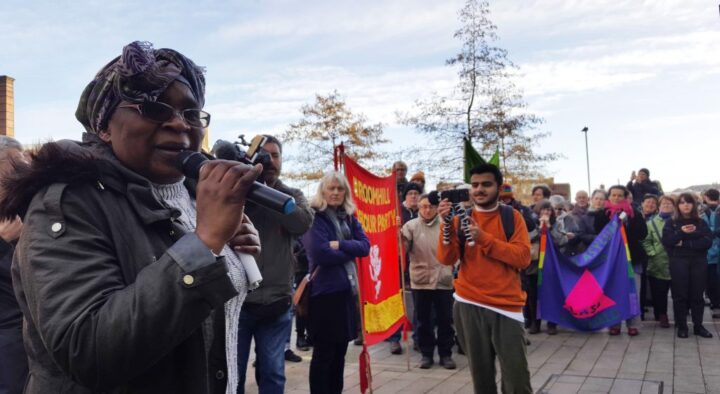
This development led the asylum organisations based in Sheffield – ASSIST, City of Sanctuary and SYMAAG – together with the faith leaders group, including the Anglican and Catholic Bishops and Muslim leaders, to urge Councillors in Sheffield to pass a similar resolution.  On 3 April 2013 Sheffield Councillors voted unanimously to support a motion condemning the prevalence of destitution amongst people who have claimed asylum in the city. The resolution, proposed by Labour Cabinet member Councillor Geoff Smith and seconded by Councillor Sylvia Anginotti for the Liberal Democrats asks the Leader of the Council to write to the Home Secretary to express concern about asylum destitution and to call for changes in the current system. Representatives from asylum supporting groups (pictured) lobbied Councillors as they went in to the meeting. The full text of the resolution is below.


South Yorkshire asylum rights groups lobby Sheffield Council

South Yorkshire asylum rights groups lobby Sheffield Council


We hope that this protest movement will now spread to many towns and cities across the country. This is certainly the objective of the coalition Still Human Still Here. Such a movement among our towns and cities will show Government Ministers that there is a substantial groundswell of opinion in favour of bringing to an end the damaging (and totally ineffective) policies that cause destitution among asylum seekers.


David Price

Chair, SYMAAG


NOTICE OF MOTION GIVEN BY COUNCILLOR GEOFF SMITH AND PASSED UNANIMOUSLY BY SHEFFIELD CITY COUNIL ON 3 APRIL 2013

That this Council:


(a)       welcomes the initiatives by Glasgow & Bristol City Councils in passing a motion highlighting concerns about refused asylum seekers and the lack of support for them in the UK;


(b)       commends the work with refused asylum seekers in Sheffield by organisations such as City of Sanctuary, Northern Refugee Centre, SYMAAG and ASSIST;


(c)        shares the concerns raised by groups working with refused asylum seekers about the levels of destitution in Sheffield and the associated problems this creates; and


(d)       asserts that if Sheffield’s proud declaration as the country’s first City of Sanctuary is to be meaningful and worthy of its fine words, we must act to improve this situation in the following ways;


(i)         the Leader of the Council writes to the Home Secretary and Chief Executive of the UK Border Agency seeking changes to their policy toward refused asylum seekers; and


(ii)        the Leader of the Council sends a copy of this letter to:


1.         The Home Affairs Select Committee for consideration during its inquiry into Asylum;


2.         Sheffield MPs to support the content of this motion and to raise the matter in the House of Commons; and


3.         The Local Government Association to encourage other councils in the UK to follow Sheffield’s lead.


COMPASS Asylum Housing Contracts: “Crude Price Cutting”. 2 Investigations Underway

The disastrous COMPASS asylum housing contracts, including the regions contracted to G4S, are being investigated by Home Affairs Committee’s Inquiry into Asylum. Confirmation that “scrutiny of the COMPASS contract will certainly form part of our work” came from the chair of the committee, Keith Vaz in a letter to local MP Paul Blomfield on April 3rd.


No Experience

The Committee will hear detailed evidence about the COMPASS contracts, particularly from evidence submitted by the Joseph Rowntree Foundation (JRF) and the Housing and Migration Network, itself drawing on evidence collected by SYMAAG and the No to G4S campaign. Describing some of the fundamental problems with the privatised COMPASS contracts, the report points out that:


  • “Contracts were awarded principally on price without regard to overall best value of the tenders and experience of the tenders”.
  • The tendering process was “a potent mix of crude price cutting and lack of due dilligence”
  • “Contractors…had no experience of providing this type of accommodation”
  • “Contractors have no experience of, and little interest in, the wider integration of asylum seekers or of the community issues to be addressed”


IMG_1751

New Contracts Could Cost More!

Also the report points out that despite the disastrous nature of the COMPASS contracts “there is clearly scope for expenditure to rise and even exceed the costs under the old contracts”.


It has also been confirmed that a separate Parliamentary investigation into “procurement issues and the performance of companies with large Home Office contracts” will take place later this year, again confirmed by Keith Vaz MP.


SYMAAG has submitted detailed evidence about the chaos and squalor that is the G4S asylum housing contract in our region. We have supported asylum seekers when they have given evidence to Parliamentary committees and legal and campaign support when UKBA and G4S have victimised them for speaking out.


Dump G4S, Serco, Clearel

We say, as we did at the start of the COMPASS contracts, that G4S are prison guards not landlords. Their record is one of abuse towards asylum seekers in this country and elsewhere. We should not be paying them public money to operate this contract. The Home Affairs Select Committee should, if it does its job properly, recommend that the G4S asylum housing contracts (and the Serco and Clearel contracts in other areas) be cancelled and transferred to properly funded not-for-profit providers in the public and voluntary housing sectors.


Stop G4S 

SYMAAG is part of the Stop G4S Campaign, Stop G4S is a coalition of activists and human rights groups dedicated to opposing G4S and working with others to Stop G4S from taking over our public services for private profit while violating human rights.

The campaign website is at http://stopg4s.net/

Facebook: https://www.facebook.com/pages/Stop-G4S/208029375963632

Twitter @stopg4s


Odette is back with us in Sheffield!

Odette was met at Sheffield Station by some of her many friends and supporters

Odette was met at Sheffield Station by some of her many friends and supporters

A determined community campaign has suceeeded in supporting Odette Sefuko and getting her released from Yarls Wood detention centre.


Odette Sefuko, Congolese campaigner against sexual violence, was detained by the UK Border Agency, who wanted to deport her to Uganda. While she was imprisoned at Yarls Wood detention (run by Serco) she was denied food because she refused to accept the identity/name given to her by UKBA/Serco! See previous articles about Odette on the SYMAAG website


Odette has been released on bail and her campaign is far from over but her case shows – once again – that a determined community campaign can successfully the injustice and abuse of asylum seekers practiced by UKBA and their profit-driven contractors like Serco, G4S, Capita, Reliance and the rest.


Marishka Van Steenbergen has been reporting on the story for the Guardian’s Northerner blog, Marishka’s latest article about Odette and the inhumanity of immigration detention is here

Kim Balmer, one of Odette’s supporters, said:
Odette’s six weeks at Yarl’s Wood highlights a system in which we have lost sight of human dignity and respect. For Odette this was far more than just a case of wrong identity. To Odette it was a death sentence, a return to the brutality and rape that William Hague is currently speaking against in his trip to the Congo.
Campaigner Peter Rowe said:
I think the only way to understand what has happened to Odette in the UK is that regrettably the politics of immigration has corrupted the due process of asylum. Someone in the middle ranks of government seems to have interpreted their brief to mean that a deportation is always a good result regardless of the circumstances. It has made our asylum process arbitrary and capricious – a kind of Kafkaesque nightmare for genuine asylum seekers like Odette.
Solicitors are now working hard to organise a DNA test with Sefuko’s sister and children, who have been recognised by the UNHCR as refugees from the DRC. The government’s current guidance on the DRC states that if an applicant is of Banyamulenge origin, granting of asylum is likely to be appropriate because they are in a vulnerable and insecure position and face persecution throughout the DRC.

Read the full article
Odette came to the UK five years ago, to seek safety and live a life free from persecution.
She is a fighter for minority rights and women’s rights in DR Congo, and now Odette is fighting for her right to sanctuary in the UK.

You can help this campaign for justice. Read more at the Facebook page, including how you can support the campaign.

“Sleepless Nights” as G4S Asylum Housing Contract Falls Apart

At a recent G4S Asylum Housing “Roadshow” event in Leeds, G4S Director Steven Small was eager to reassure his critical audience that he’d suffered “sleepless nights” over the disastrous G4S COMPASS asylum housing contract. Were we supposed to feel sorry for him? To put the suffering of asylum tenants – months of stress, squalor and abuse – into context? To appreciate the commitment of this man (a former Rentokil pest-control executive) to the welfare of asylum tenants?


One month after the Leeds “Roadshow” PR event it is clear why Mr Small was having sleepless nights.

  • After protests from women asylum seekers, asylum rights groups, Leeds City Council and national press coverage, G4S sub-contractors Cascade were suspended from the COMPASS housing contract in West Yorkshire for 3 months
  • A leaked G4S letter dated February 25th (seen by SYMAAG and authenticated by G4S), reveals that another sub-contractor, Mantel, had resigned from the Midlands contract on 30th January
  • The same letter explains that 2 other subcontractors, “Live (Management) and Cascade have also expressed similar concerns to Mantel,” but goes on to say that they have not (yet, at least) been dumped
  • According to “G4S Assessments” (an “entirely separate” company from G4S apparently) 18 per cent of properties in South and West Yorkshire allocated to asylum seekers were unfit (from a random sample of 366). If these figures hold for all Yorkshire properties run by G4S and their subcontractors Cascade and Live Management Group, then perhaps 300 asylum seekers and their families are living in unfit properties.
  • G4S and its (current and former) sub-contractors have victimised asylum tenants who have dared speak out against them leading to local defence campaigns and exposure in the national press.
  • National and Parliamentary awareness of the G4S asylum housing disaster has grown: inquiries by the Home Affairs Select Committee and the Chief Inspector of Immigration into G4S and asylum housing are pending. Even the Shadow Minister for Immigration, Chris Bryant was moved to comment: “The hideous conditions in which many people live. We need to do far more in this country to crack down on unscrupulous and poor landlords, who put people into housing that, frankly, is not fit for living. It has been a disgrace that successive Governments have not concentrated enough on that.”


Those asylum tenants who have courageously spoken out against G4S and their (dwindling number of) sub-contractors are now seeing the results of their efforts to be treated like human beings. An alliance of asylum rights groups, anti-privatisation campaigners, trade unionists, Stop G4S activists and tenants’ rights groups stands alongside them.


G4S’ Steven Small’s desperate letter pleads: “What it does not mean is that G4S is willing to give up on COMPASS.” (emphasis in original). Our job over the next few months is to get G4S and other private contractors off the asylum housing contract. Last summer our campaign forced sub-contractors UPM off the COMPASS contract. With Mantel now dumped, Cascade suspended, Live Management not far behind and Target Housing discredited we can do it. Soon, G4S and Mr Small, their pest-control expert, will be left without any sub-contractors.


We maintain our view that G4S are prison guards not landlords. Their record is one of abuse towards asylum seekers in this country and elsewhere. We should not be paying them public money to operate this contract. People seeking asylum have the same rights to decent social housing as anyone else in this country.


More details of the leaked G4S letter and the collapse of the G4S COMPASS contracts can be found in Clare Sambrook’s recent article for Open Democracy Another G4S scandal: are the UK’s asylum housing subcontractors falling apart?


SYMAAG’s John Grayson has recently written an analysis of who has profited from the privatisation of asylum housing Their secret is out, but for G4S and friends ‘abject disregard’ for human dignity persists


The Independent newspaper has extensive coverage of the latest G4S asylum housing disaster here


and finally….

Even the Tory-supporting, privatisation-loving, migrant-baiting Daily Telegraph has a go at G4S here


Serco/UKBA Try to Starve Odette into Submission

Latest News: 14/3/13

Despite a court ruling that the Home Office have not handled Odette’s asylum claim properly (they ordered a judicial review of her case) she is still imprisoned at Yarls Wood detention centre. What’s more UKBA and Serco (who profit from running Yarls Wood) refuse to acknowledge Odette’s identity. They insist on referring to her by a different name -and saying she’s from Uganda not the Democratic Republic of Congo). Even to receive meals in Yarls Wood you need an ID card! Serco have issued Odette with an ID card with someone else’s name on it. When Odette has refused to be called by a name imposed on her by UKBA and Serco they have refused to let her eat or allow her access to medication.


The campaign for Odette has been protesting to Serco about their attempts to coerce Odette into accepting their view of who she is! Odette’s Facebook campaign page here has plenty of ideas for ways to continue to show our support for Odette. It’s called CADOS – Campaign Against the Deportation of Odette Sefuko)


In particular Odette the campaign are encouraging complaints to Serco at Yarls Wood detention centre:


What You Can Do (From the CADOS Campaign page)

Odette is still being denied proper meals, medication and some post at
Yarl’s Wood because she won’t use the wrong Christine Mpoza ID. This is
making her ill physically and psychologically. To complain about her
needs being unmet, please email Katie.beaumont@serco.com
FAO Katie Beaumont, Admin Assistant, Yarl’s Wood IRC

Important: When you’re not satisfied with reply, enclose it with a
covering letter saying why you’re not satisfied to:
The Prison and Probation Service Ombudsman PPO
The Prisons and Probation Ombudsman
Ashley House
2 Monck Street
London
SW1P 2BQ
Email: mail@ppo.gsi.gov.uk
Telephone: 020 7035 2876 or lo-call 0845 010 7938
Fax: 020 7035 2860


Latest News: 5/3/13

A well-organised and widespread campaign, a determined legal team and the courage of Odette Sefuko proved too much for the UK Border Agency. Odette was on a bus to Heathrow Airport, due to be deported to Uganda (even though she is from the Democratic Reppublic of Congo – DRC) when her legal team won the right for a judicial review of the way UKBA have handled her claim for asylum. In simple terms, it means that Odette has not been justly and properly treated by the UKBA: a point made by the thousands of people who supported her right to seek safety in the UK.


 Solidarity

At the time of writing Odette is still in Yarls Wood detention centre but her victory means that UKBA must consider her claim for asylum again. This time, thousands of Odette’s supporters will be watching to ensure she gets justice. Odette’s role as women’s rights campaigner in the DRC was one of the reasons she was forced to look for somewhere safe to live outside her country. It is fitting that the solidarity she showed with women raped in the DRC has, in turn, been showed to her by friends and strangers in Sheffield and beyond.

A Model Campaign

Her campaign was well-organised: with a bold public presence on the streets of Sheffield; publicly co-ordinated through social media; it gained the support of women’s groups; faith groups, the Congolese community; experienced campaigners and used local and national media effectively. It pushed politicians who said they supported Odette into taking action and making public statements. It drew on established anti-deportation resources, like those of the National Coalition of Anti-Deportation Campaigns and the experience of local campaigners. It drew in people who didn’t know much about the issue of asylum, politics in the DRC or the way the UK Border Agency treat people looking for safety in the UK. It was an education for many of us.


Anti-Deportation Movement

Odette’s battle for her right to live safely in the UK goes on but she will be pleased to know that the mobilisation for her will help future anti-deportation campaigns establish themselves more quickly and effectively. Perhaps we can start to talk about an anti-deportation movement in South Yorkshire, as well as support for individual campaigns for asylum in our region.


For the latest news about Odette see her her campaign Facebook page

Sheffield’s Marishka van Steenbergen has written another excellent article, this time about Odette’s success for the Guardian Northener blog here


Latest News: 28/2/13

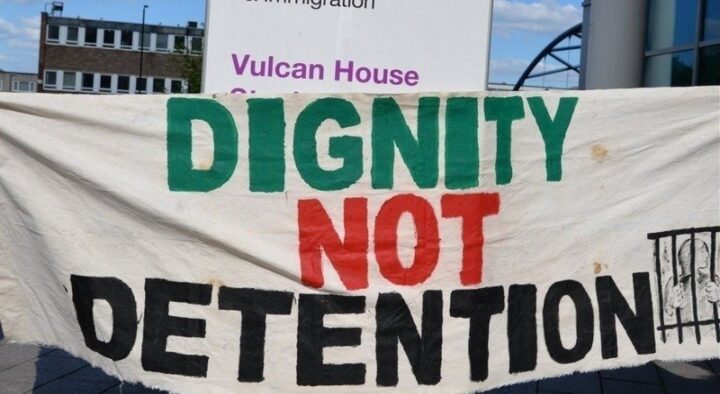
60 people rallied on the steps of Sheffield Town Hall on Wednesday 27th in support of Odette Sefuko, threatened with deportation to Uganda (even though she is from the Democratic Republic of Congo). We marched to UKBA’s Vulcan House to make our point directly.

odettedemo(2)


Sheffield’s Marishka van Steenbergen has written an excellent article about Odette’s case for the Guardian Northener blog here


To keep up to date with Odette’s campaign see her Facebook campaign page.


What can we do to defend her? Sign her online petition, ask your MP, womens group, trade union branch or faith group to support her. Template letters and background information are on her Facebook campaign page.


odettedemo(1)

pics by David Price of SYMAAG


Some background about Odette Sefuko

Prominent anti-rape campaigner from Sheffield – and the Democratic Republic of Congo - Odette Sefuko has been detained by UKBA. They want to deport her (to Uganda!) on Monday March 4th. We can stop them.


‘Umoja Ninguvu’  – ‘Together we are strong”


ODETTE SEFUKO is from the Democratic Republic of Congo (DRC). She came to claim asylum in the UK because her life was threatened. She was imprisoned, tortured and raped for trying to help women who had been raped – she led a group called ‘Umoja Ninguvu’ (‘Together we are strong”) – and because she is Bunyamulenge; an ethnic group that have been persecuted in DRC for many decades. Many of Odettes family have also been murdered. Odette is seeking asylum under the 1951 UN Convention on the Status of Refugees, her claim was refused by the tribunal court, she is now seeking an appeal. The Home Office do not want to accept that Odette is Congolese, despite reputable evidence. They want to send her to Uganda, where she might face imprisonment, torture, rape or death


G4S “Roadshow” a Write-Off


Latest News: The last night of any tour is usually the climactic highpoint. Not this one: A request to attend the Newcastle “Roadshow” scheduled for March 28th brought this response from the office of G4S executive Stephen Small:

“We have suspended roadshows for the moment and will be rearranging in the near future”

No reason was offered but the cancellation coincides with the recent meltdown of G4S’ sub-contractors in Yorkshire, Humberside and the Midlands


*********************


G4S has launched a laughable public relations exercise to re-assure us that – despite all the evidence – the G4S COMPASS asylum housing contracts are running smoothly.


“Certain Areas”

“Colleagues, partners and Councillors” were invited to attend a series of events in Yorkshire and Humberside (and the other G4S COMPASS area – Midlands and east England) so that G4S could respond to “certain areas which have been highlighted regarding property standards, property procurement and relationships with key stakeholders” as G4S move into the “business as usual” period of the COMPASS contract. This was never going to be an easy job given the torrent of protest, resistance and adverse national publicity surrounding the contract ever since G4S received £120 million to operate it from last year.


Not “going forward”

The “G4S COMPASS Roadshow” consisted of a dozen quick 2 hour sessions due to start in Barnsley (but advertised as “Sheffield”) on February 14th, ending in Newcastle on March 28th. But it looks like the Roadshow has already crashed: the Barnsley event was cancelled after “substantially less than 15 people” had booked to spend 2 hours of their time listening to G4S talking about “the implementation of our property portfolio going forward”. The decision to cancel may have also been influenced by the fact that of these “subtantially less than 15 people” many were asylum tenants and campaigners who wanted to discuss “certain areas” of the G4S contract which the security company would doubtless prefer that we forget.


No sell out

At the time of writing the Roadshow is still intending to appear at a number of venues around the region. The deadline for booking your place was officially February 8th but it seems unlikely that the tour will sell out. Also, asylum tenants and campaigners might want to highlight “certain areas” of the contract by having an un-missable presence outside the venues.


Details of (currently) scheduled Roadshow venues are below.


Date

Time

Location

Thursday 14th February 10:00 – 12:00 Sheffield CANCELLED
Monday 18th February 9:00 – 11:00 Leeds
Thursday 21st February 10:00 – 12:00 Birmingham
Monday 25th February 10:00 – 12:00 Walsall
Wednesday 27th February 10:00 – 12:00 Leicester
Thursday 28th February 10:00 – 12:00 Nottingham/Derby
Monday 4th March 10:00 – 12:00 Stoke
Monday 18th March 10:00 – 12:00 Peterborough
Monday 25th March 10:00 – 12:00 Norwich  SUSPENDED
Tuesday 26th March 14:00 – 16:00 Hull  SUSPENDED
Wednesday 27th March 10:00 – 12:00 Middlesbrough  SUSPENDED
Thursday 28th March 10:00 – 12:00 Newcastle  SUSPENDED


If you would like to join us, please confirm which roadshow you would like to attend to Jennifer Robertson by the 8th February through the following channels:


Email: Jennifer.robertson@uk.g4s.com


Tel: 07525 734944


Latest (vague) UKBA “Concessions” to Syrian nationals in UK

Latest Vague Statement from UK Government regarding Syrian nationals in the UK 28/2/13

http://www.publications.parliament.uk/pa/cm201213/cmhansrd/cm130228/wmstext/130228m0001.htm#13022844000004

Home Department

Immigration Concession for Syrian Nationals

The Minister for Immigration (Mr Mark Harper): I am today announcing the renewal of concessions to the immigration rules for Syrian nationals lawfully in the UK.

28 Feb 2013 : Column 34WS

In the light of the ongoing violent conflict in Syria it has been decided that the UK Border Agency (UKBA) should continue to operate some discretion to enable Syrians legally in the UK to extend their stay here.

Syrians in the UK with valid leave (or leave which has expired within the last 28 days) in specified visa categories will continue to be able to apply to extend their stay in that visa category, or switch into a different specified category from within the UK (with some restrictions) rather than being required to return home first. Those applying will still need to meet the requirements of the relevant visa category, pay the appropriate fee, and adhere to the normal conditions of that category—no access to public funds, for example. If a required document is not accessible due to the civil unrest in Syria UKBA may apply its discretion and the requirement to provide that document may be waived where appropriate.

These concessions will remain in force for one year from today. The Government continue to monitor the situation in Syria closely in order to ensure our response is appropriate and that any emerging risks are addressed.

I am placing a copy of the authorisation for this concession in the Library of the House.


In a vague statement, Immigration Minister Mark Harper responded to concerns and protests about the potential deportation of Syrian students in the UK in an answer to a parliamentary question


Update as of 4th February

from Hansard, see http://www.publications.parliament.uk/pa/cm201213/cmhansrd/cm130204/text/130204w0001.htm#13020440000042

Deportation: Syria

Mr Jim Cunningham: To ask the Secretary of State for the Home Department (1) if she will support Syrian students at universities in the UK who are facing deportation as a result of being unable to access funds due to the conflict in Syria; [140661]

4 Feb 2013 : Column 23W

(2) how many Syrian students studying at UK universities potentially face deportation as a result of being unable to access funds because of the conflict in Syria; [140664]

(3) what recent representations she has received on reports that hundreds of Syrian students studying at UK universities face deportation to Syria where they will be at risk of detention and torture. [140665]

Mr Harper: Officials from the Department of Business, Innovation arid Skills are aware of a number of students and universities affected by the situation in Syria and are working with Universities UK to identify ways to enable students from Syria to continue their studies in the UK. We are not aware that any students have been removed from their courses as a direct result of the political situation in Syria and the impact this has had on their ability to access funding.

We appreciate the potential challenges faced by students living in the UK who wish to receive money from countries that are subject to financial sanctions and look favourably on licence applications to the Treasury to enable the financing of education.

As a result of the exceptional situation the UK Border Agency has allowed Syrian students in the UK to extend the period of their visas or switch visa route where the immigration rules would have otherwise prevented them from doing so.


The UK Government claims that it supports those Syrians fighting the dictatorship of Assad but now it threatens to deport Syrian students who can’t pay their university fees because funding has stopped.

syrian_student1


When the UK Border Agency threatened to deport Libyan students in 2011, SYMAAG, alongside Libyan community organisations, student groups and other campaigners protested. The Libyan Government had cut funding to students in the UK who had demonstrated against Gaddafi. UK universities were persuaded to defer payment of fees from these Libyan students, stopping their deportation to Libya and likely persecution.


We think that:

  • UK universities should cancel or defer student fees for Syrian students
  • UKBA should change its policy regarding deportations to Syria. Recent UKBA rulings put the lives of Syrian students and asylum seekers in the UK in danger by threatening to deport them


This article first appeared in the Huffington Post
14 January 2013 by Lucy Sherriff http://www.huffingtonpost.co.uk/2013/01/14/syrian-students-face-deportation-death-torture-tuition-fees_n_2472639.html


Syrian Students In UK Face ‘Deportation, Torture, Death’ As Cannot Pay Tuition Fees

Hundreds of Syrian students face being expelled from the UK and sent back to their home country, where they could face torture and even death, the Huffington Post UK has learnt.


Up to 650 students face deportation to Syria where they may be subject to “detention, torture and even assassination at the hands of the Syrian regime”.


Due to the conflict in Syria, many students can no longer pay their tuition fees as their sponsors have either been killed or imprisoned, meaning they cannot afford to continue studying.

syria torture

It’s claimed that students risk being detained and tortured if they return to Syria
 

Mo Saqib, a third year student at Manchester University, is campaigning for the UK government to assist students whose degree funding has been cut by the Assad regime. Along with Christine Gilmore, a PhD student a Leeds University, he has been accruing evidence of the plight of Syrian students.


He told HuffPost UK: “The UK government’s position is that it’s up to universities how to assist students- we have evidence of universities who have already expelled students, and others who have threatened to do so. Expelled students will then be deported to Syria, where they risk being detained and tortured, or even killed, by the Assad regime.


“Their lives are at greater risk if they are suspected of having supported the Syrian revolution while in the UK. The UK government needs to step in and help Syrian students just as it was able to Libyan students in the same situation.


“The UK government assisted Libyan students in this situation once the UK had recognised the Libyan National Transitional Council (NTC) as the legitimate representative of the Libyan people. The UK government arranged for the Libyan students’ liability to be registered against the NTC. In November, William Hague recognised the Syrian National Coalition (SNC) as the “sole legitimate representative” of the Syrian people- why has the government not entered talks to make such an arrangement with the SNC?”


He added: “For those students not sponsored by the government, but by family or companies instead, their families members are now either dead or out of work, and many businesses have closed or been destroyed,” Saqib says.


According to Saqib, many universities have transferred the financial liability onto the Syrian students – despite them having no means of paying.


“A number of universities have already expelled students. Others have made clear to students that the financial liability is on them – either they will be expelled, or the qualification will be withheld until the fees are paid.


“Should Syrian students be sent back home they face detention, torture and even assassination at the hands of the Syrian regime.”


syrian students

A letter from Salford University to a Syrian institution asking for immediate tuition fees payment – otherwise the student will be removed from the course
 

The National Union of Students is now considering launching a campaign on behalf of the Syrian students to force the British government to guarantee them financial support. At least 100 students were sponsored by the Syrian government under the British Council’s capacity building scheme but have had their funding stopped by the Syrian authorities.


According to the NUS, the students face “severe financial penalties from the Syrian authorities”. HuffPost UK has seen a draft motion for the NUS’s policy executive, which states:


“Syrian students whose student visas lapse and lose the right to work risk destitution in the UK.


“The British government must make an uncompromising commitment to supporting the rights and freedoms of the Syrian people. The foreign secretary William Hague ensured that Libyan students affected by the conflict in 2011 were able to continue their studies and should extend this gesture to all Syrian students.”


Foreign office minister Alistair Burt tweeted instructions to Syrian students on Monday, adding he urged universities to use their discretion:


alistair burt

Despite Burt getting involved in the students’ plight, Saqib says this is simply not good enough.

“Mr Burt has left the matter to universities’ own discretion, some of whom are expelling students. If a student is expelled, they may also be deported back to Syria, where they risk being detained, tortured or killed as the regime continues to indiscriminately target innocents.

“Mr Burt appears to think that the matter is one of transferring funds over to the UK. He is wrong, as students’ sponsors are either dead or out of work, hence unable to accrue funds,” Saqib adds.

“Furthermore, banks in Syria are also controlled by the regime and they are unlikely to fund students they suspect of engaging in anti-regime activities.”

leedsunievidence1

A letter from the University of Leeds warning of expulsion unless fees are paid
 

Liam Burns, president of the NUS, told HuffPost UK: “The situation in Syria is devastating enough without universities turning their backs on those currently studying in the UK. What we urgently need to see is every Syrian student is given support when finances aren’t forthcoming so they can continue their studies.


“This has to be the least the UK can do considering the tragic circumstances of the conflict in Syria.”


The NUS is discussing a motion to urge all UK universities to waive or reduce the tuition fees, or extend the payment period for any Syrian student affected by the conflict.


“UK universities should not make any Syrian student sponsored by the Syrian government personally liable for their tuition fees but should register their tuition fees debts against the Syrian authorities,” the NUS adds.


“[We resolve] to request all UK universities to make hardship grants, scholarships and bursaries available to all affected Syrian students, whether sponsored or privately funded, to cover their living expenses.”


The British Council said it had established a hardship fund to support the living costs of the 100 Syrian scholars who are studying in the UK through the Syria Higher Education Capacity Building Project. So far, it has paid, or in the process of paying, grants to 58 of the 100 scholars to help support their living costs during this 12/13 academic year.


A spokesperson for the council said: “We have supported Universities UK in negotiations with the partner universities who are hosting the Scholars, and all of the project partner universities have agreed to defer or waive fees for this 12/13 academic year and some until the end of their course. We also understand some of the universities have agreed to defer fees for all Syrian students (i.e. Manchester). However in some instances this has not stopped Finance Departments from automatically sending out letters requesting fee payments similar to those illustrated.”


There are eight partner universities in the UK involved in the scheme: Brunel, Edinburgh, Essex, Heriot-Watt, Manchester, Marjon (St Mark and St John), Newcastle and Warwick.


Huw Morris, academic vice-chancellor at the University of Salford, which is not involved in the scheme, said: “The University considers all requests for help from students in hardship on their merits. We have already been in contact with our Syrian students to offer one-to-one advice and support tailored to their personal circumstances and, should we receive any hardship applications from these students, we will consider them fully and sympathetically.”


The university insisted it had a full support package for the students, including the opportunity to apply for hardship funds.


“Our Student Life welfare team has already been in contact with all our Syrian students to offer support and, at the time we were contacted by Huffington Post, none had made an application for hardship funds,” a spokesman said.


Jacqui Brown, head of the University of Leeds International Office, said: “Any student at the University of Leeds who is suddenly left destitute and is unable to pay their tuition fees can apply for financial support from the University and this includes students who have been affected by the conflict in Syria. We would encourage any of our Syrian students who have concerns about financial hardship to contact the Student Advice Centre.


Saqib is eager to stress any students who feel their lives are at risk if they are deported can can claim asylum in the UK. He can be contacted via Twitter: @Mo_Saqib.


SYMAAG invited two Syrian refugees to a SYMAAG meeting last October. More details here

Leeds Council Order G4S to Review All Asylum Housing

A campaign led by two women asylum seekers has prompted Leeds City Council to take action against G4S. After visiting some of the squalid properties which G4S had tried to house people in, senior council officials ordered G4S to “undertake a full review of the property portfolio in Leeds to ensure they meet the contract standards”.


 Cockroaches

One of the women who led the campaign, Ms A, along with her baby son, had been allocated a property in Leeds by Cascade Housing, a G4S housing subcontractor. The house was filthy, infested with cockroaches and the floors and walls were rotten with damp. Metal grilles covered the lower floor windows and the upstairs windows did not open wide enough to escape in case of fire.


Ms A refused to accept the property and was taken to another Cascade house in the city. This house was also filthy with mould covering almost all of the interior. When she refused to accept this place as a home for her and her baby Cascade staff tried to forcibly prevent her from leaving the property. It was only after the intervention of some local people that Cascade let her leave the property, agreed to take her back to the original (cockroach-infested) property and promised to move her again. This move never came. Instead, Cascade carried out cosmetic “repairs” painting over mould, laying linoleum over rotten, damp, spongy floorboards. During this time Ms A experienced racial harrassment at night with people banging on the metal window grilles. One day she found a cockroach inside her baby’s bottle. Ms A contacted refugee agencies and campaigners and with the support of other women asylum seekers pushed Leeds City Council to intervene.


Standing Up to G4S

Leeds City Council’s Housing Regulation Team and G4S visited Ms A’s house and three other squalid properties in the city. Following the visits, G4S agreed to re-house all four women in the properties and to fully repair the four houses before they are used again to house human beings. Recognising that these cases are not isolated ones, Leeds City Council is insisting that G4S reviews all of its asylum housing in the city. Sheffield, Teeside, Bradford, Hull, Kirklees and other local authorities in our region should pay tribute to the courage of women asylum seekers who stand up to the might of UKBA, G4S and their subcontractors and do the same.


A Bad Week For G4S and Asylum Housing Subcontractors

The story of Ms A was reported in The Independent newspaper on 14th December, four weeks after Cascade Housing and G4S dumped her there. On Monday 10th December The Independent published a story about the eviction of a heavily pregnant asylum seeker – she was due to have an induced birth on the day that Target Housing (another G4S subcontractor) forced her to move in Rotherham. The CEO of Target Housing at the time of this eviction, Gino Toro, is now employed by G4S as their “Social Cohesion” manager in the Midlands.

How G4S Broke the Asylum Housing Contract

The deadline for the completion of the COMPASS asylum housing contract in Yorkshire and Humberside by G4S was originally the start of September. When G4S failed to meet this target, UKBA extended it. A new “final deadline” - 12th November - was set by UKBA. When it became clear that they would fail again, G4S demanded that local authorities (who G4S had undercut to win the contract) pay to house asylum seekers for an extra month.  

Despite breaking the contract and failing to meet the November 12th deadline, UKBA gave G4S another four ”final weeks” to do the job that they are being paid £135million of public money for in Yorkshire and Humberside. On December 4th G4S’s Stephen Small (with the chilling title of ”Managing Director of G4S Immigration and Borders”) stated “We are pleased to have completed the transition of all the people in our care”. Two days later, Mr Small’s colleague at UKBA, Simon Walker, announced “COMPASS Project – Transition Complete” in a Corporate Partner Letter – End of Transition.

The story of Ms A’s squalid housing in Leeds indicates how G4S reached the latest UKBA-set deadline of 7th December. Her story, though shocking is not unusual, according to reports reaching us from around our region. Families from South Yorkshire have been moved 120 miles away from their friends, legal representation, support and communities to Teeside. In Teeside, Leeds and South Yorkshire people have been placed in areas where organised racist attacks are frequent. “Compliance checks on properties” have not been carried out before people have moved in. Glossy G4S “Welcome Packs” have not been completed with local details, making them useless to new residents.

Angel Lodge on Love Lane

The letter from UKBA’s Simon Walker trumpetting the End of Transition tells us of another way that G4S have “completed the transition”. Walker explains guardedly that “asylum applicants dispersed to this area are now entering the G4S managed Initial Accommodation facility at Love Lane in Wakefield before moving on to G4S managed accommodation across the North East, Yorkshire and Humber”. The beautifully named “facility” on “Love Lane” in Wakefield is in fact the notorious Angel Lodge Initial Accommodation in the shadow of Wakefield Prison. This is not asylum housing, it is “Initial Accommodation”: the place where people seeking asylum are first housed when they reach the UK, before they are housed. One 8 year old child of an asylum seeking woman in Huddersfield found himself back at Angel Lodge where he came when he was one year old and newly arrived in the UK. In an attempt to “warehouse” people seeking asylum to mask their inability to properly house them, G4S are dangerously overcrowding Angel Lodge.

For all of these reasons and in solidarity with the women asylum seekers of Leeds we repeat our call for an investigation into G4S’ use of public money to force asylum seekers into squalor.

G4S’ Handling of Asylum Housing Should Be Investigated:

Take Action: contact your MP and ask them to demand an investigation into the UKBA/G4S handling of the asylum housing contract.

You can find contact details of your MP here

A template letter is here for you to download MP letter template – Investigate G4S

Join the Campaign to Investigate the G4S Asylum Housing Contract: see website of Stockton North Labour MP Alex Cunningham

G4S Break Asylum Housing Contract: Investigate G4S!


Once again, private security company G4S, has failed to meet its obligations to fulfill a contract paid for by public money. This time it’s the COMPASS contract to re-house people seeking asylum in Yorkshire and Humberside. Despite a contract extension until November 12th hundreds of asylum seekers in our region face a further agonising wait until a G4S van turns up with instructions to move up to 120 miles away to properties often unfit to live in.


In their rush to meet contractual deadlines G4S and their sub-contractors have:

  • Housed women and young children in “hostel accommodation” in Stockton-on-Tees described as “cell-like” by the women, run by Jomast, a sub-contracting company owned by a multi-millionaire
  • Moved families with children during term-time (despite assurances from UKBA that it wouldn’t), requiring a damaging change of school by children who need security and stability, not uncertainty and disruption
  • Moved families far away from their community, legal and medical support structures. Dozens of families have been evicted from their South Yorkshire homes and sent to Teeside, despite UKBA’s assurances to the contrary
  • Evicted a pregnant woman in Rotherham on the day she was to have an induced birth. Sub-contractors Target Housing were concerned that they wouldn’t be paid unless the woman was moved that day
  • Evicted single tenants and replaced them with families or groups, maximising profit: the old Rachmanite trick of “winkling”.
  • Placed people in areas where racist attacks are commonplace, failing to notify the local police or social services of the existence and whereabouts of vulnerable people
  • Moved people to unsuitable and sub-standard accommodation: a disabled Iraqi woman in Sheffield was told she had to use an upstairs toilet in her new ‘home’ despite explaining, in advance, that her disability made this impossible.


Resistance

There has been resistance: women from the “cell-like” Stockton hostel have called for its closure and recently gave evidence to a Parliamentary inquiry about the degrading conditions there. Many people have refused to sign agreements to accept unsuitable new housing and worked with campaigners and legal representatives to demand decent housing. Complaints have been lodged about male housing staff harrassing women asylum seekers in their own homes and one G4S sub-contractor, United Property Management, was dumped after they tried to force a woman and her baby to live in unhealthy and insanitary conditions. Some people have even preferred to be homeless than be forced to live in areas where racist attacks occur daily.


National Attention

SYMAAG is pleased to see that this issue is now receiving national attention with detailed coverage in the Independent newspaper and from respected social housing organisations like Inside Housing and 24 Dash. There’s been public criticism of the G4S/COMPASS contract from local authorities, who were undercut by G4S in the bidding process and are now (incredibly) blamed by G4S for the company’s failings.


With widespread evidence of contractual failure, even the Labour Shadow Immigration Minister Chris Bryant was pushed to comment: “The Home Secretary clearly has some serious questions to answer and should investigate this shambles as a matter of urgency.”


“I Don’t Want a Prison Guard as My Landlord”

But for asylum seekers and campaigners the fact that G4S are clearly a “shambles” isn’t the main question. Why was a security company with no housing experience awarded a housing contract? Why was a company facing multiple complaints and investigations regarding abuse of asylum seekers in detention and during forced deportations even considered as suitable? Why didn’t UKBA listen when asylum seekers told them “I don’t want a prison guard as my landlord” ? What controls and penalties exist to hold G4S to account: not just for their incompetence but for their attitude and record towards asylum seekers? As ‘Ruth’, seeking asylum from Kenya, told a reporter “These companies just want to make profits. But we are human beings.”

When the 12th November contractual deadline passed: according to an Inside Housing report, ”G4S referred all press enquiries on the matter to the UKBA” and “The UKBA declined to say what, if any, sanctions G4S might face”. UKBA have now extended G4S’ deadline to house all asylum seekers in Yorkshire and Humberside by a further 4 weeks. As G4S and their sub-contractors rush to try to meet the latest deadline, we can expect more attempts to dump human beings into inhuman living conditions, more excuses from G4S while UKBA look the other way and more resistance to private companies trying to profit from human vulnerability.

G4S’ Handling of Asylum Housing Should Be Investigated:

Take Action: contact your MP and ask them to demand an investigation into the UKBA/G4S handling of the asylum housing contract.

You can find contact details of your MP here

A template letter is here for you to download MP letter template – Investigate G4S

When SYMAAG met Nick

Just before the last general election SYMAAG sent an “Asylum Election Pledge” letter to all candidates in South Yorkshire. The letter was backed by 30 refugee community organisations, campaign groups, faith groups and trade union branches. Many candidates replied to say they agreed with 6 key points which, if implemented, would go some way to showing respect for the rights of people seeking asylum in the UK. One of them was Nick Clegg, elected as MP for Sheffield Hallam, and now Deputy Prime Minister.


Nick Clegg’s stated support for key asylum rights began earlier: In July 2008 at public meeting in Sheffield, over 200 people heard him declare his support for asylum seekers’ right to work and for the ending of the detention of asylum-seeking children.


Clegg: “The asylum system is uniquely unfair” Sheffield Town Hall, 2008


 In 2012 there’s no right to work for asylum seekers and child detention continues despite Clegg’s incredible claim that the Coalition Government has ended it. But Nick Clegg, a patron of local asylum-support charity ASSIST, continues to argue that he and the Liberal Democrats are for asylum and migrant rights. So, on 16th November 2012, representatives from various Sheffield-based asylum-rights groups met the Deputy Prime Minister and “put our concerns” to him. This was the third such meeting: reports and assessments of the others can be found here and here


Report from Meeting with Nick Clegg, Sheffield 16th November 2012


On 16 November, representatives of SYMAAG, together with representatives of other asylum organisations in Sheffield, ASSIST, City ofSanctuary Sheffield, Northern Refugee Centre and Sheffield CDAS, met Nick Clegg, MP for Sheffield Hallam. It was the third such meeting since  the formation in 2010 of the Coalition Government in which he is Deputy Prime Minister.


The team from the asylum organisations  was Richard Chessum for ASSIST, Sam Musarika for Sheffield Committee to Defend Asylum Seekers (CDAS),  Mike Reynolds for City of Sanctuary Sheffield, Jan Thompson for Northern Refugee Centre (NRC) and John Grayson and David Price for SYMAAG. It was a short meeting but covered a lot of ground.


David Price began by remarking that, as they had said at previous meetings, they did not feel that the asylum system had fundamentally changed from what it was like before the last General Election – the ‘culture of disbelief’ was still in evidence.


G4S and Asylum Housing. John Grayson spoke about the effect of G4S taking over asylum housing in Yorkshire and the North East – people being moved into awful premises, Angel Lodge being reopened as initial accommodation, moves  into areas where asylum seekers suffered abuse from the far right, the shocking hostel for mothers and children in Stockton on Tees (subject of an inquiry led by Sarah Teather MP the following week). G4S were behind with the contract – 300 people had yet to be moved out of Council accommodation in Yorkshire. SYMAAG was drawing together a case to put to the Chief Inspector of Immigration and Asylum in the hope of a thorough inspection. Various points were discussed:

  • How did moves to the North East come about?  Mainly at this stage from the fact that G4S held both the contract for initial accommodation and for longer term accommodation.  
  • What scrutiny did UKBA give to homes into which people were to be moved? Not much.
  • What was the previous quality of housing? Councils had on the whole ensured observance of minimum standards.


Deportation to dangerous countries. Mike Reynolds drew attention to various recent cases, referring particularly to the Justice First report on deportations to the Democratic Republic of the Congo (DRC) in which out of 17 cases 13 were abused on return. He called for the monitoring of returns and said that there were moves in the voluntary sector  to develop a national monitoring network initially concerned with DRC, Uganda and Afghanistan.


Family Migration. David Price said that SYMAAG had held a meeting at which great concern was expressed about the new family migration rules introduced in July. He suggested that it was highly discriminatory against poor people and poor regions such as South Yorkshire to require an income of £18,600 to bring a spouse into the country (and more for children).  

Nick Clegg said that, but for the Liberal Democrats, the limit might have been much higher. But he was less sympathetic with SYMAAG’s arguments here than on asylum issues where the UK had entered into international obligations.  Every country had to have rules to control immigration. David Price pointed out that both Yemenis and Pakistanis in Sheffield considered the new rules damaging to their communities. Councillor Maroof’ had put a motion on this to Sheffield Council which had been accepted. There were disturbing individual cases. Nick Clegg said he thought it worthwhile to look at the option of regional differentiation of the income threshold.  Richard Chessum, referring to a particular case, urged that when asylum seekers were given leave to stay they should be allowed to bring in close family members.


Young asylum seekers. Jan Thompson  expressed concern about the way in which judgements about the age of young asylum seekers were handled and referred to one case where the authorities had been slow to recognise that a young Afghan had learning difficulties.

Nick Clegg undertook to investigate what monitoring the UKBA had in place to check on different local authorities and their policies on assessing the ages of young asylum seekers.


Legacy Cases. Richard Chessum said that there were tens of thousands of cases that had been unresolved for years – the situation was very stressful for those involved who could not work or get on with their lives. UKBA tended to dismiss fresh claims as not sufficiently different to previous claims to justify pursuing them – thus leaving people in limbo.


Clegg summed up by saying he would follow up G4S (sub-standard housing, Angel Lodge etc), post-return monitoring, possible regional differentiation of income requirements for family migration, age assessments and fresh claims in legacy cases.


We will be watching carefully (but not waiting) for any progress…